After 15 years in family law, the most frequent question I get is: “What should I do?” The question may stem from a proposal, a parenting or financial decision, or whether to continue moving forward with a particular process. The specific question may be different, but the concern underneath it is often the same.
People come to family law attorneys during some of the most stressful periods of their lives. They are making decisions about their children, their finances, their homes, and their future at a time when emotions are at an all-time high and certainty can feel hard to find. It is natural to want someone to tell you the right answer. I don’t think those questions have easy answers, and I don’t think there is one right answer for every family or every person.
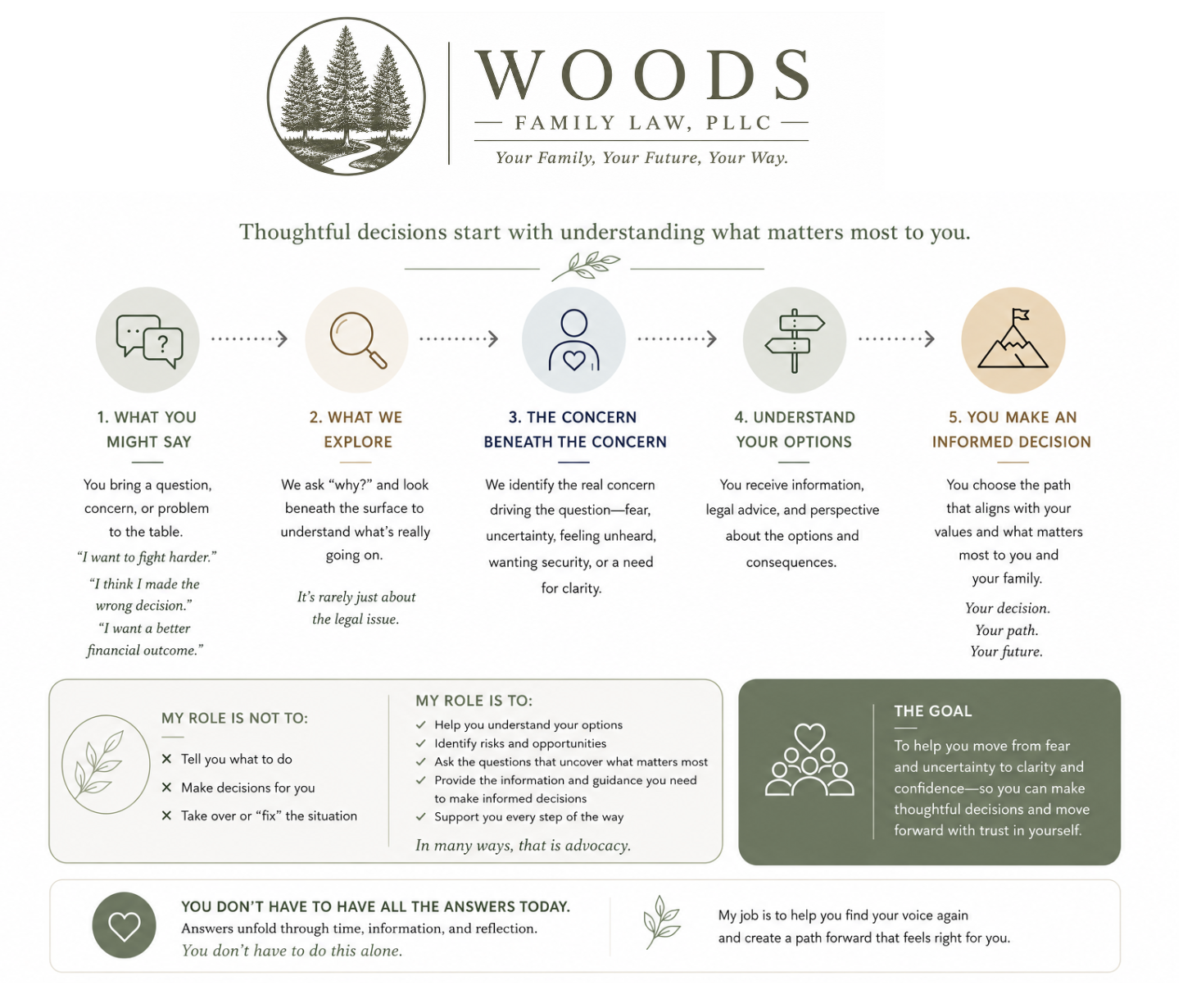
Over the years, I have found that what clients are struggling with is often different from the issue they initially bring into my office. A client may tell me they want to change tactics. Another may be convinced they made the wrong decision. Someone else may be focused on a particular financial outcome or parenting arrangement. When that happens, one of the first questions I tend to ask is: “Why?” Not because the concern is unimportant, but because understanding why something feels so important is often the first step toward making a thoughtful decision about what to do next.
A client may tell me they want me to fight harder. Sometimes that is a conversation about advocacy. More often, it is a conversation about feeling unheard, powerless, or afraid that no one is standing up for them. Until we understand that concern, it can be difficult to know what kind of advocacy will serve you best. The legal issue matters, but before we can decide what to do, it is worth understanding what concern we are actually trying to address.
Many people assume a good attorney’s role is to tell them what to do or to take over when things feel overwhelming. I understand why. When you are frightened, exhausted, or uncertain, having someone else make the decision can feel reassuring. The challenge is that your attorney is not the person who has to live with those decisions. You are.
The agreements you reach, the parenting arrangements you create, and the choices you make during this process will continue to affect your life long after your case is over. While an attorney can provide legal advice, perspective, and experience, only you can decide what matters most for you and your family. This is why I see my role differently.
Ultimately, those decisions belong to you. My role is to help you understand your options, think through the consequences of those options, and make sure you have the information you need to make informed decisions for yourself. That may feel uncomfortable at times, particularly when you are looking for certainty. However, I have found the decisions people feel best about are often the ones they make after taking the time to understand their options, reflect on what matters most, and choose a path that aligns with their values. Sometimes that means helping you see risks you had not considered. Sometimes it means slowing down before making an important decision. Sometimes it means asking questions that help uncover the concern underneath the concern. In many ways, I think that is advocacy.
I want my clients to finalize this process feeling more confident in their ability to make difficult decisions than when they started. Not because divorce is easy or because every decision becomes clear, but because they have taken the time to understand what matters most to them and have made choices that reflect those values. The goal is to make thoughtful decisions.
You do not need to have every answer today. Many answers unfold through the process with time, information, and reflection. You do not need to navigate this process alone, and you do not need to pretend that it is easy. What you do deserve is the opportunity to thoroughly understand your options, reflect on what matters most, and make decisions that feel right for you and your family. Over time, that process becomes something more than resolving a legal case. It becomes an opportunity to find your voice again.
And while I cannot tell you what future is right for you, I can help provide the information, perspective, and guidance that allow you to move forward with greater clarity, confidence, and trust in your own decision-making.